
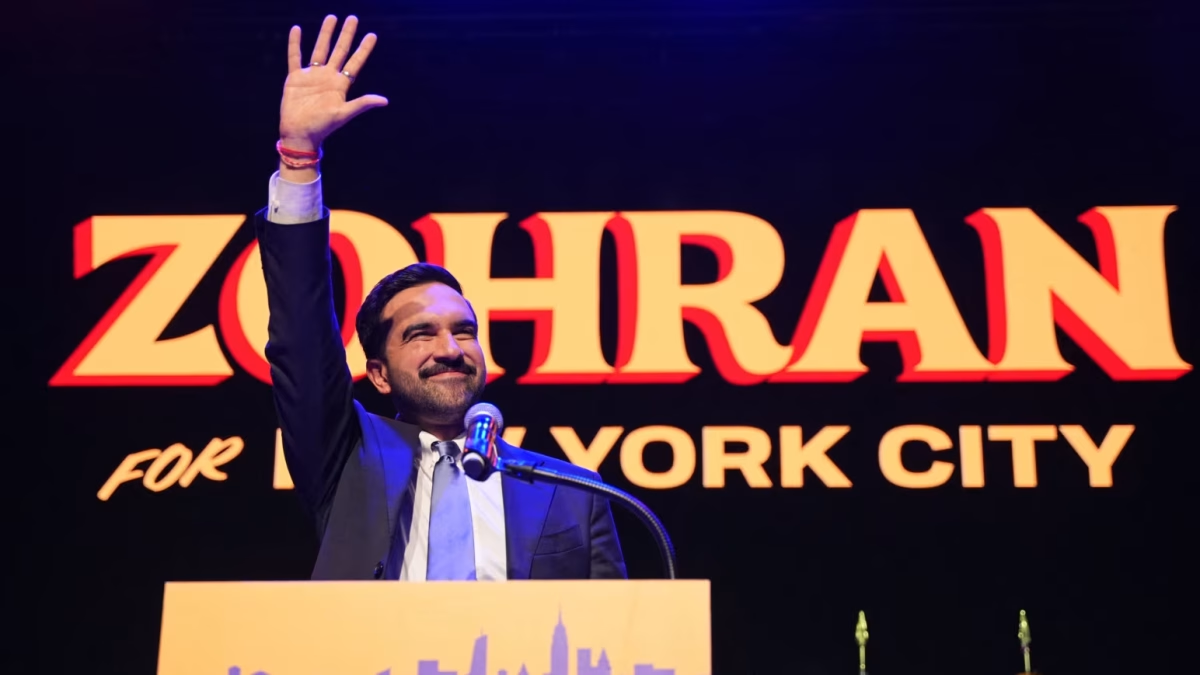
On the night of Nov. 4, 2025, Democratic Socialist Zohran Mamdani was declared the new mayor-elect of New York City against Independent Andrew Cuomo and Republican Curtis Sliwa. Despite backlash from both Republicans and Democrats over his political and economic stances, those very ideas successfully won over the youth of N.Y.C., turning the polls in his favor. But what exactly is democratic socialism, and how will this win affect the future of both the city and country?
Zohran Mamdani was born on Oct. 18, 1991, in Kampala, Uganda, to Indian parents of Muslim faith, renowned professor Mahmood Mamdani and Oscar-nominated filmmaker Mira Nair. He and his family moved to the Upper West Side of Manhattan when he was 7 years old because his father was hired by Columbia University. Many critics like to use his privileged upbringing against him, but he has stated in the New York Times that “I have always been honest as to how I have grown up and the ways in which my parents’ successes in academia and film allowed me to have a childhood that every New Yorker should have.”
After attending the Bronx High School of Science, Mamdani graduated from Bowdoin College in Maine with a degree in Africana Studies. During his time there, he worked on the student newspaper, The Bowdoin Orient, and co-founded the campus’s chapter of Students for Justice in Palestine. Before his career in politics, he was a housing counselor in Queens, helping homeowners fight foreclosure. He met his wife, Syrian artist Rama Duwaji, on Hinge, and the two married in May 2025, 3 years after they began dating.
Zohran Mamdani is a member of the Democratic Socialists of America (DSA), a left-wing organization founded in 1982 with over 85,000 members, including Senator Bernie Sanders and U.S. Representatives Alexandria Ocasio-Cortez and Rashida Tlaib. Though some call Mamdani and other democratic socialists “communists”, the two ideologies do, in fact, have differences. Communism aims to eliminate the class divide and private ownership of production under capitalism by replacing it with a system in which everyone contributes to society based on their ability. As individuals, everyone receives what they need to survive. Socialism, on the other hand, aims to minimize class divide and private ownership of production under capitalism by replacing it with a system where everyone contributes according to their ability and gets back what they deserve for how much they contribute.
Furthermore, democratic socialism differs from other types of socialism. Unlike some socialists who hope to achieve socialism through a revolution ending in a one-party system, democratic socialists hope to achieve socialism by using and preserving the existing democratic means. There are currently no true democratic socialist countries, but examples of social democracy, an ideology that mixes the private ownership of capitalism and the social welfare programs of socialism, can be found in Norway, Sweden, Finland, and Denmark—countries that are also known for being some of the happiest in the world.
Zohran Mamdani has many changes planned for New York City. Some of the most notable are his plans to freeze the cost of rent for apartments, crack down on neglectful landlords, tax the wealthy, raise the minimum wage to $30/hr by 2030, and establish city-owned grocery stores, fare-free buses, free childcare, and greener schools to fight back against the climate crisis. Other plans of his also directly oppose President Donald Trump’s newly implemented tariffs, attacks on various social services, and deployment of U.S. Immigration and Customs Enforcement (ICE) to cities across the country.
While his beliefs are popular among marginalized groups like women, people of color, LGBTQ+ people, and Muslims, many Jewish people, among others, have been concerned about Mamdani’s anti-zionist values, equating them to antisemitism. Anti-zionism has been associated with opposing the war in Gaza, along with Israel’s Prime Minister Benjamin Netanyahu. However, a more accurate definition of anti-zionism would be the opposition to a Jewish state established through the colonization of Palestine and the forced displacement of Palestinian Arabs. Mamdani’s views align more with the traditional definition of anti-zionism, as he stated on Fox 5’s Good Day, New York that he disagrees with the concept of Israel as a Jewish state, “Because I’m not comfortable supporting any state that has a hierarchy of citizenship on the basis of religion or anything else”. However, criticism towards the modern state of Israel is not the same as hostility, prejudice, or discrimination against Jewish people, and equating the two blurs the line between antisemitic speech and Palestinian advocacy.
At 9:34 p.m. on Nov. 4, Associated Press (AP) called the New York City mayoral election and declared that Zohran Mamdani had won with 50.8% of the vote, overtaking Andrew Cuomo (who ran as an independent after losing the democratic primary) by 9.5%. AP’s decision team also stated that Mamdani gained more votes than any NYC mayoral candidate in over half a century. CNN’s exit polls showed voters aged 18-29 made up 28% of the vote, a great increase from previous elections, with Mamdani winning 75% of them. Not only that, but young women and youth of color voted for him 20% more than young men and white youth.
The results of the N.Y.C. mayoral election, along with other 2025 elections, show growing voter disappointment with how President Trump and the Republican Party have handled U.S. affairs. They also show a shift among young voters toward more leftist (anti-capitalist) values rather than liberal (capitalist reform) ones, a contrast to the anti-leftist paranoia of the 20th century. No one can truly predict the effects of Mamdani’s win on other state or federal governments, but if his administration succeeds, leftist candidates will likely reach a higher level of popularity than ever anticipated.