
This article contains graphic descriptions of the material and topic. Reader discretion is advised.
On Jan. 15, 1947, Betty Bersinger was strolling peacefully through a Los Angeles neighborhood with her child. The glimpse of something out of place near the edge of the sidewalk made the mother pause, and she cautiously inched forward with trepidation. Upon inspection, Bersinger saw a body, mangled on the ground. Bersinger originally believed the young woman to be a mannequin since she was posed in such a manner; however, her hopes were dashed when reality hit.
The dead woman was sliced in half at the waist. Her clothes were missing, and she had clearly been subjected to extensive mutilations on her body. The intestines that were supposed to have been inside the woman’s body were missing, among other gruesome details. Also present was a grisly smile slit into her face, leaving the citizens of Los Angeles haunted for years to come.
The oddest aspect of this murder, however, was the absence of blood from the crime scene. With a murder so brutal, crimson splattering the pavement would be expected, drawing unsuspecting eyes in the direction of the horrific discovery that was this poor woman’s body. In spite of this expectation, none was found. This abnormality indicated that some sort of medical tool or piece of equipment was used to draw the blood out of her body. This process would had to have occurred in a location other than the one in which she was found. These haunting details exhibit the expertise of the murderer, and could suggest a background in the medical field. The body was most likely also washed prior to its disposal in the Los Angeles neighborhood, further aiding the murderer in removing every last drop of blood from inside or on the victim’s body.
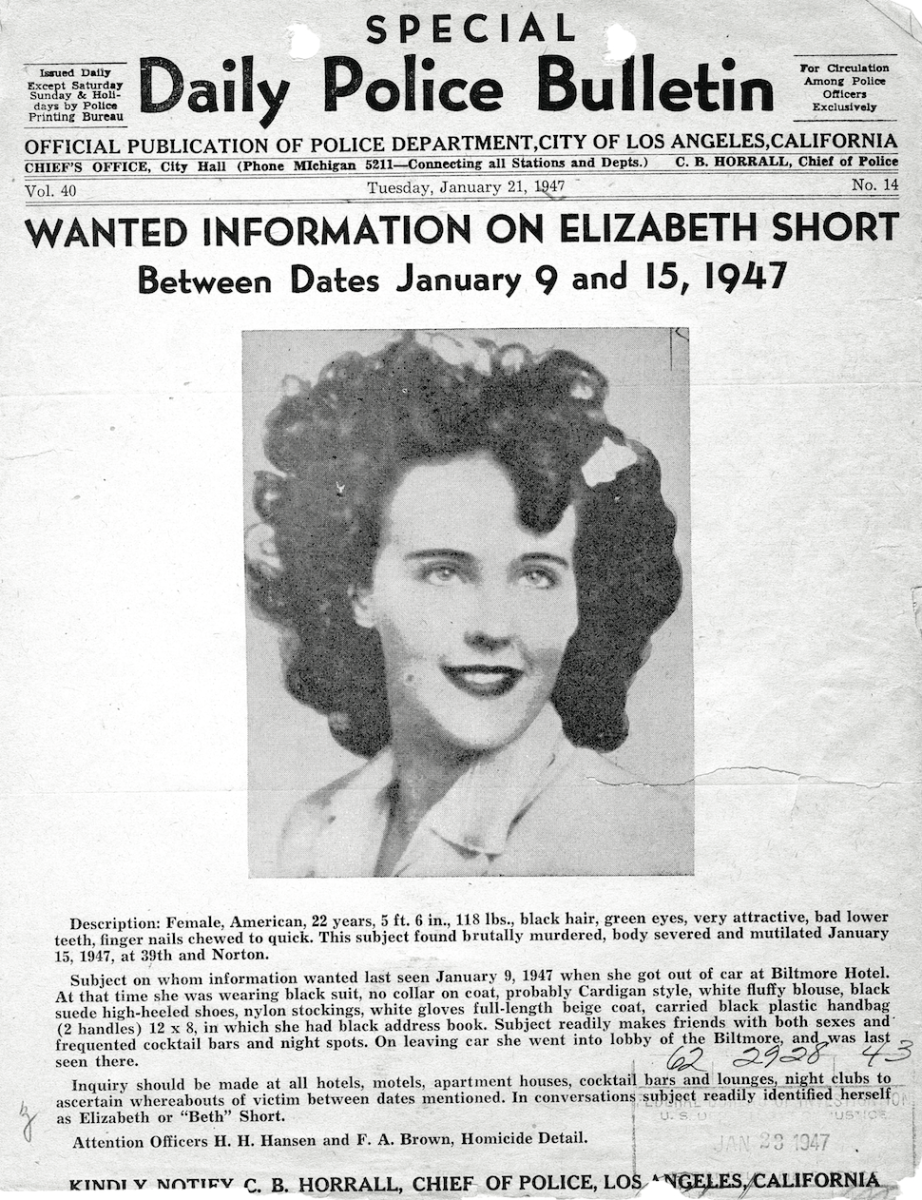
Soon after Betty Bersinger called the police, the Los Angeles Police Department swarmed the scene and began the investigation. The Federal Bureau of Investigation was also called in to identify the body shortly afterwards, using blurred fingerprints from “Soundphoto” (a new machine at the time capable of transferring information through telephone lines) to confirm the body belonged to 22-year-old Elizabeth Short, a young woman reaching for the stars. Short had been an actress at the start of her career, hoping to one day work her way up to Hollywood. Instant fingerprint identification resulted from already having Short’s in the database, as she had previously applied to work at the Army’s Camp Cooke in California as a clerk in 1943. In the same year, she got into a bit of legal trouble when she was caught drinking underage. Short’s infamous nickname relating to her case was inspired by her best movie at the time, The Blue Dahlia, and by the all-black attire she was said to have frequently sported.
The investigation was fundamentally fruitless; no major discoveries were made, and any progression was slow. An anonymous letter was addressed to the Los Angeles Examiner and was received by various other Los Angeles newspapers on Jan. 24, 1947, with the messenger declaring that they were the killer. Within the envelope, cut-outs of letters from ads were used to spell out words, preventing the chance of someone recognizing the culprit’s handwriting. The letters spelled out: “Here is Dahlia’s belongings.” These included Short’s address book, birth certificate, business cards, and some photographs. The murderer was clever once again, and cleaned all of the items with gasoline before sending them to the papers. 75 men from Short’s address book were interviewed with no luck, and any leads became a dead end.
Keck School of Medicine, the medical school of the University of Southern California became another area of interest for a time. This was due to the evident medical proficiency of the killer, but this idea eventually fizzled out as well.
Elizabeth Short’s murder remains a sizable mystery to this day, puzzling the country and reigning as the most infamous crime in Los Angeles. Perhaps one day, the case will be solved, and the young woman’s murderer will be brought to justice. But for now, the case remains cold, and will continue to attract attention until it is finally solved.